
When a Tanker Becomes a Defendant. The U.S. Legal Machinery Behind Seized Oil Tankers
This article provides a practical and legally grounded explanation of the U.S. civil forfeiture process applied to oil tankers linked to sanctioned Iranian petroleum trade. It examines how vessels are identified through compliance investigations, designated under U.S. sanctions programs, and ultimately become defendants in in rem forfeiture proceedings before federal courts. The article further explains DOJ forfeiture complaints, vessel arrest procedures, interlocutory sale of cargo, CAFRA requirements, claimant rights, statutory deadlines, and the possible disposition of vessels and cargo proceeds. Designed for shipowners, operators, charterers, P&I Clubs, insurers, banks, maritime lawyers, and compliance professionals, this guide offers a clear understanding of the legal framework governing maritime sanctions enforcement and the commercial risks associated with sanctioned shipping operations. It is intended as an educational resource based on publicly available U.S. statutes, court procedures, and admiralty law.
MARITIME LAWCIVIL FORFEITUREADMIRALTY LAWTANKER SEIZURESANCTIONS
Chintapalli Venkata Balaji, Marine Surveyor/Auditor and Maritime Lawyer
7/6/20267 min read
Preface
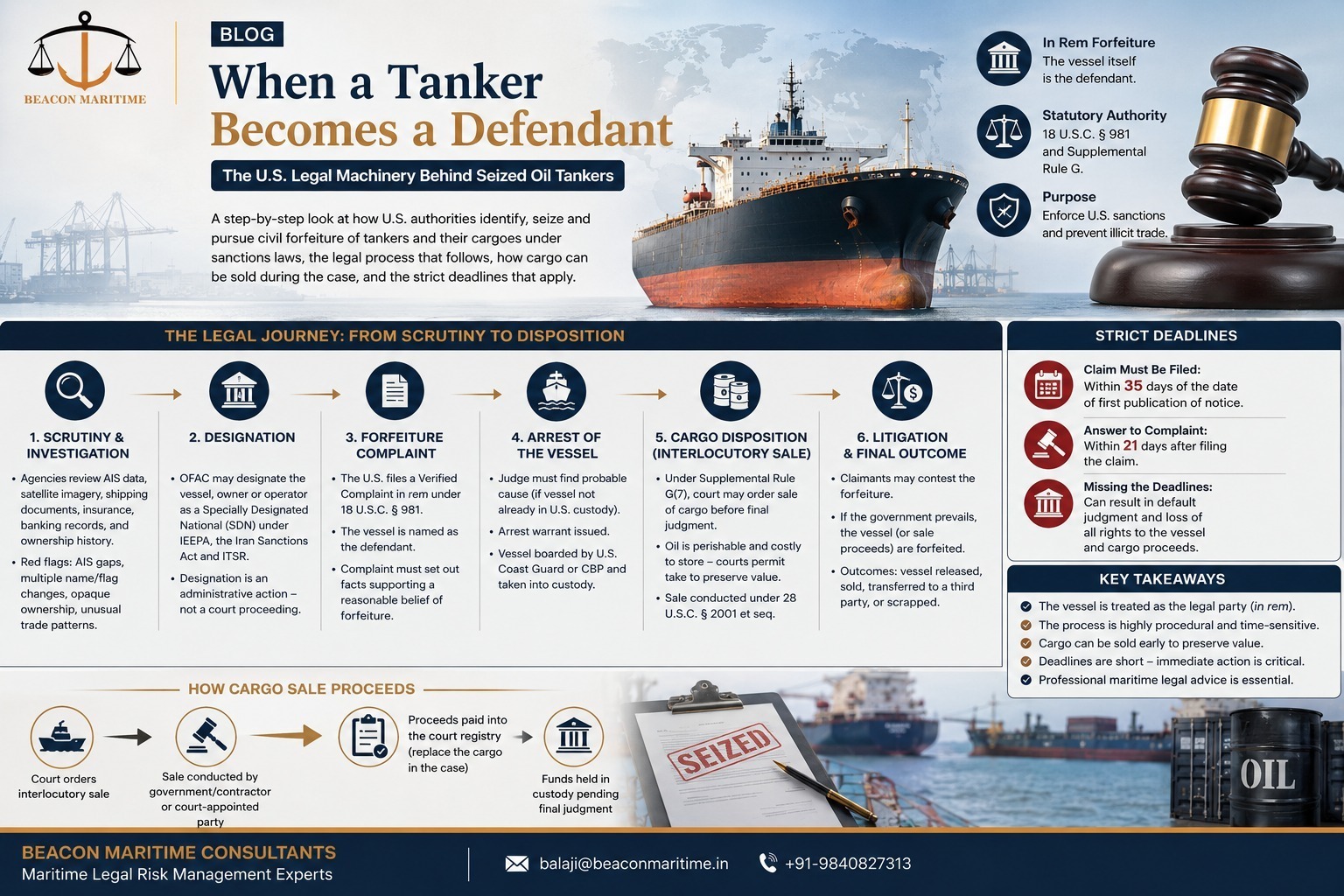
Every so often, a headline appears in the maritime press: an oil tanker has been seized, or a sum of money tied to a cargo of oil has been forfeited to the U.S. government. A few months later, a quieter follow-up story often appears — the cargo has been sold, the proceeds have been placed in a government account, and the vessel itself may be released, sold separately, or scrapped. Most readers move past these stories quickly. But behind each one sits a detailed, highly procedural body of U.S. law – one that treats the vessel itself as a legal party to a case, runs on statutory deadlines measured in days, and can result in a cargo being sold before any hearing on the merits has taken place.
This process is not improvised. It draws on a specific set of U.S. statutes and federal court rules – some dating back decades – that were originally written for general admiralty and forfeiture matters and have since been applied to vessels connected to sanctioned trade in Iranian-origin crude oil. This piece sets out, in plain terms, how that legal process actually works: how a vessel comes to the attention of authorities, how a forfeiture case proceeds, how a cargo can be sold while litigation is still ongoing, and what deadlines apply to anyone seeking to contest the action. The aim here is descriptive, not evaluative — this is an explanation of a legal mechanism, not a comment on the policy or politics behind the underlying sanctions themselves.
How a Vessel Comes to the Attention of Authorities
Before any legal filing is made, a case typically begins with a review of publicly and commercially available information. Agencies such as the U.S. Treasury Department, the U.S. Coast Guard, and Homeland Security Investigations may review satellite imagery, AIS (Automatic Identification System) tracking records, insurance filings, banking records, and shipping documentation to assess whether a vessel's movements or transactions are consistent with the conduct that a sanctions regime is designed to restrict. Indicators that may draw scrutiny include extended gaps in AIS tracking data or a documented history of changes in a vessel's name, flag, or ownership structure within a short period.
The underlying legal authority for sanctions on Iranian petroleum trade comes primarily from the International Emergency Economic Powers Act (IEEPA), together with the Iran Sanctions Act and the Iranian Transactions and Sanctions Regulations set out in the Code of Federal Regulations. Under this framework, the Treasury Department's Office of Foreign Assets Control (OFAC) has the authority to designate a vessel, its owner, or its operator as a Specially Designated National (SDN). This designation is an administrative action taken by Treasury; it does not itself involve a court proceeding. Once made, the designation generally requires U.S. persons to block any property interest connected to the designated party.
It is worth noting that designation and physical seizure are two distinct legal events. A vessel may be designated without ever being taken into U.S. custody. Moving from a designation to actual custody of the vessel requires a separate process that runs through the federal courts rather than through Treasury.
The Forfeiture Action: The Vessel as the Named Party
U.S. law provides for a distinct type of legal proceeding known as civil forfeiture “in rem” — a Latin term meaning “against the thing". In this type of case, the vessel itself is named as the defendant in the litigation, rather than an individual or company. A case might therefore be captioned as an action against a named vessel, rather than against a person.
The statutory authority for this kind of forfeiture is found in 18 U.S.C. § 981, and the governing procedure is set out in Supplemental Rule G of the Federal Rules of Civil Procedure — a rule specifically written to govern forfeiture actions of this kind. To begin the process, the government files a verified complaint that must describe the vessel with particularity, including details such as its IMO number and history of name or flag changes, and must set out sufficient factual detail to support a reasonable belief that the government will be able to meet its burden of proof at trial. Courts have required a meaningful factual basis in these complaints rather than general or conclusory statements.
If the vessel is not already in U.S. custody, a judge must find probable cause before an arrest warrant for the vessel can be issued. That warrant authorises the physical boarding of the vessel, typically carried out by the U.S. Coast Guard or U.S. Customs and Border Protection. Once boarded under this authority, the vessel is considered to be under arrest in the admiralty sense of the term — in government custody, with its disposition now subject to the forfeiture proceedings.
Disposition of Cargo During the Proceeding
In many of these matters, a vessel's cargo is sold before the underlying forfeiture case is fully resolved, sometimes within weeks of the seizure, even where the litigation itself continues for a year or more.
This outcome reflects a practical reality rather than any particular policy stance: crude oil is a depreciating, storage-intensive commodity, and courts have long recognised that requiring the government to hold a large volume of oil for an extended period pending litigation is neither efficient nor cost-effective. Supplemental Rule G(7) accordingly permits an interlocutory sale — a sale that takes place before final judgement — where retaining the property pending trial would be impractical. The sale itself follows judicial-sale procedures set out in Title 28 of the U.S. Code and may be carried out by a government agency, a contractor acting on the government's behalf, or another party designated by the court.
Once the cargo is sold, the proceeds take its place in the litigation. This is referred to as a “substitute res”: the forfeiture case continues against the cash proceeds rather than the physical cargo, with the funds held in an interest-bearing government account pending the outcome of the case. This is why public reporting on these matters often refers to the forfeiture of a specific sum of money in oil proceeds, even where the vessel itself is handled through a separate and sometimes different resolution.
The Legal Standard Applied in Forfeiture Proceedings
The substantive framework governing these cases comes primarily from the Civil Asset Forfeiture Reform Act of 2000 (CAFRA), codified largely at 18 U.S.C. § 983.
Under this framework, the government bears the burden of establishing, by a preponderance of the evidence, that the property is subject to forfeiture. The government is permitted to rely on evidence obtained after the complaint is filed, including material developed during discovery. Where the forfeiture theory is that a vessel facilitated a violation — for example, by carrying cargo subject to sanctions restrictions — the government must also demonstrate a substantial connection between the vessel and the underlying conduct.
A party asserting an interest in the vessel or cargo — such as a registered owner, a mortgage-holding financial institution, or a charterer — may raise the innocent owner defence under 18 U.S.C. § 983(d). Under this provision, a claimant bears the burden of showing, by a preponderance of the evidence, that they did not know of the conduct giving rise to forfeiture or that, upon learning of it, they took reasonable steps to address it. Separately, a claimant may also argue under 18 U.S.C. § 983(g) that forfeiture of the full value of a vessel would be grossly disproportionate to the underlying conduct under the Excessive Fines Clause of the Eighth Amendment. Where a court agrees, it has authority to reduce the forfeiture rather than order forfeiture of the property in full.
Notice and Response Deadlines
Because forfeiture proceedings involve the government taking property without a criminal conviction, the applicable rules place particular emphasis on notice and defined response periods.
The process generally begins with notice to the public and to any known interested parties. Public notice is often satisfied by posting the case on an official government forfeiture website for a set period, commonly 30 consecutive days. Separately, the government has an obligation to provide direct notice to any party who reasonably appears to hold an interest in the vessel — this may include the registered owner, the operating company, a mortgage-holding bank, or the relevant flag registry.
Once notified, a potential claimant is generally given a defined window — commonly in the range of 30 to 60 days, as specified in the notice — to file a formal claim asserting an interest in the property. A claimant who does not file within that window may lose the ability to participate further in the proceeding. Once a claim is filed, the claimant then has 21 days to file a formal answer to the government's complaint. Where a party is shown to have had actual knowledge of the proceeding through some other means, courts have generally held that any technical defect in the formal notice process does not, on its own, invalidate the proceeding.
Closing Observations
Taken as a whole, this framework operates on two different timelines. Practical matters – such as the disposition of a depreciating cargo – are typically resolved relatively quickly through the interlocutory sale process available under Supplemental Rule G. The underlying legal questions — including ownership, knowledge, and the sufficiency of the connection between the property and the alleged conduct — are resolved over a longer period, under the evidentiary framework set out in CAFRA, subject to defined and relatively short deadlines for anyone seeking to contest the action.
For parties with commercial exposure to vessels operating in sanctioned trades — including owners, financing institutions, insurers, and compliance professionals — the practical significance of this framework lies less in the outcome of any single case and more in its procedural timelines. The deadlines involved are specific, generally non-extendable absent court order, and failing to meet them can affect a party's ability to be heard in the proceeding at all.
This article is provided for general informational purposes and does not constitute legal advice. It describes U.S. legal procedure as a matter of public record and is not intended to express a view on the merits, legitimacy, or political dimensions of any sanctions regime or enforcement action. Parties involved in an actual forfeiture matter should consult qualified admiralty and forfeiture counsel.
Chintapalli Venkata Balaji is the founder of Beacon Maritime Consultants and a former chief engineer and ex-classification surveyor/auditor with over 30 years of experience in the maritime industry. He currently leads the maritime techno-legal consultancy at Beacon Maritime Consultants. His expertise spans classification and statutory surveys, marine audits, and complex maritime casualty and salvage operations.